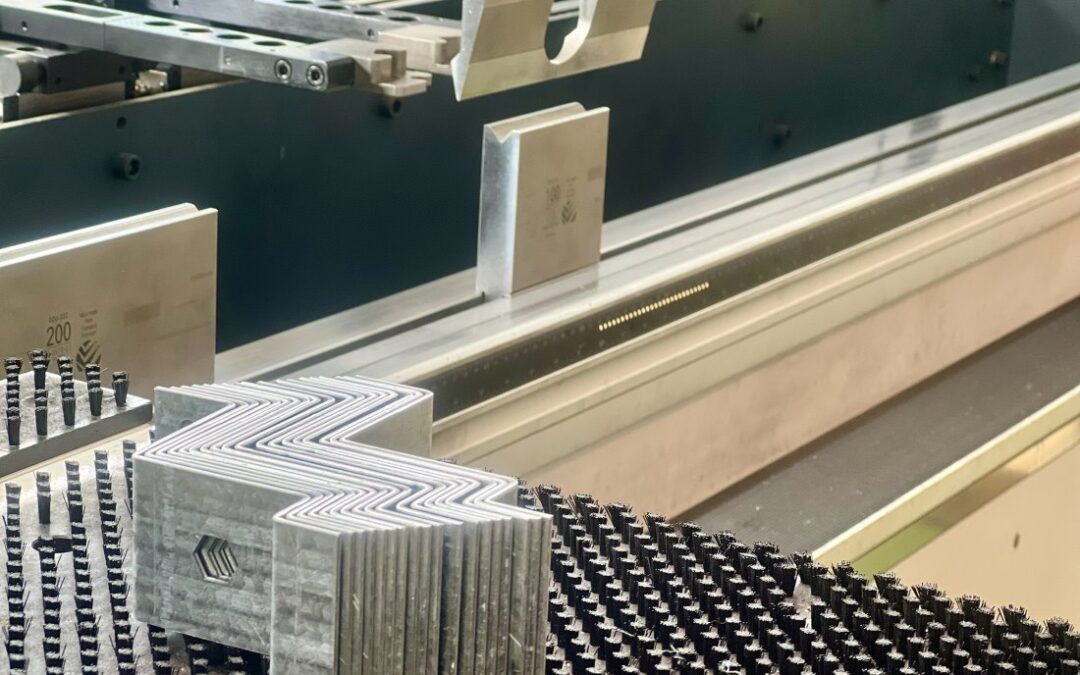
In modern metalworking, speed and precision have become key competitive advantages. Market demands for shorter lead times, higher quality, and greater flexibility have pushed companies to adopt advanced solutions. One of the most significant technological shifts of the past decade is the introduction of robotic bending—a process that combines industrial robotics with CNC press brakes and brings a revolution to sheet metal processing. Robotic bending is not just automation of manual labor; it is a comprehensive transformation of the production process that raises quality standards, reduces costs, and paves the way toward the smart factory of the future.
Robotic sheet metal bending is an automated process in which an industrial robot, working in combination with a CNC press brake, takes over all handling operations—gripping, positioning, rotating, and unloading the workpiece. The robot replaces the operator in the most demanding, repetitive, and risky tasks, while the CNC machine performs the bending operation with high precision.
How Does a Robotic Bending System Work?
The robotic bending cycle follows clearly defined steps:
- Material feeding: The robot picks up the sheet from a pallet or loading table. Vacuum or magnetic grippers ensure secure handling, while the system automatically checks for double-sheet picking.
- Positioning and alignment: The workpiece is precisely positioned in the press brake working area. This is achieved using mechanical stops, vision systems, or automatic adjustment of the back gauge. Accurate calibration between the robot and machine coordinate systems is critical.
- Feeding into the press brake: The robot feeds the sheet along a predefined path between the upper and lower tools. Before the upper beam descends, the robot stabilizes the part and reduces grip pressure. Communication between the robot and the machine takes place in real time via industrial protocols.
- Bending: The press brake performs the bending according to the programmed parameters. The robot maintains workpiece stability and retracts after the operation. Advanced sensors and feedback loops ensure bending accuracy within ±0.2° to ±0.5°.
- Repositioning and rotation: For multi-step bending, the robot adjusts the sheet orientation—rotating, tilting, or flipping it—and repeats the cycle. Smart path-planning algorithms prevent collisions.
- Unloading and palletizing: After bending is complete, the robot places the finished part in a designated area or palletizing station. Some systems also include inline quality inspection and automatic sorting.
Capabilities of Robotic Bending
Modern robotic bending systems support a wide range of materials and dimensions. They process aluminum, sheet steel, stainless steel (inox), copper, brass, and PVC. Tooling enables bending of materials from 0.4 mm to 6 mm in thickness, with maximum bending lengths of 1500 mm or more.
Robot positioning accuracy ranges from ±0.02 mm to ±0.06 mm, and when combined with automatic angle compensation, ensures consistent quality for every part in a series. These systems are capable of continuous 24/7 production without human presence, making them ideal for large-scale manufacturing with near-zero tolerance.
Key Advantages of Robotic Bending
High repeatability and consistent quality
In mass production, identical parts are essential. Robots repeat each cycle with the same precision and under identical conditions—regardless of time, fatigue, or operator experience.
Increased productivity
Robots operate continuously without breaks or shift changes. Productivity gains compared to manual bending range from 30% to 50%. Work organization is also optimized: during night shifts, robots handle repetitive tasks, while operators focus on complex processes during the day.
Cost reduction
Reducing human involvement lowers costs associated with errors, material waste, and rework. Automation typically reduces the number of operators from two to zero or one. Energy-efficient servo-driven press brakes consume 20% to 40% less energy than traditional hydraulic systems. Cost estimation also becomes more accurate, as time, material, and energy consumption are predictable.
Safety and ergonomics
Robots handle heavy parts, eliminating risks associated with manual lifting and reducing the likelihood of hand injuries. Systems are equipped with multi-level safety features such as light curtains, laser scanners, safety fences, and interlocking mechanisms.
Flexibility and fast changeovers
Modern robotic systems support automatic recognition and rapid switching between different parts. New bending programs can be quickly generated using offline programming software, while automatic adjustment of tools and grippers enables flexible small-batch production. These systems are ideal for enclosures, electrical cabinets, ventilation ducts, and other standard industrial products.
Smart factory integration
Robotic bending systems integrate seamlessly into smart factory environments. Data on bending angles, force, cycle time, and efficiency are collected in real time and transmitted to MES and ERP systems for monitoring and traceability. This allows precise tracking of every batch, operator, and processing parameter.
Limitations and Considerations
Robotic bending is not suitable for every application. The key factor for profitability is repeatability—prototypes and one-off parts do not justify programming time. Tool configuration must also be precise, as the robot executes only what is programmed and cannot compensate for incorrectly set tooling.
Robotic sheet metal bending represents one of the most important steps toward intelligent and competitive metal production. It combines high precision, exceptional repeatability, 24/7 operation, and flexibility—all in one system. Companies that have adopted this technology report significantly lower error rates, higher product quality, and improved responsiveness to customer demands.
At a time when the shortage of skilled labor is becoming a real challenge worldwide, robotic bending systems are not just an investment in productivity—they are an investment in the future of the company.
Do you need robotic sheet metal bending for high-volume production with maximum repeatability? Choose Flamula Metal—specialists in comprehensive sheet metal processing using state-of-the-art robotic CNC systems. Everything in one place, with exceptional precision, reduced costs, and zero defects.